Tuesday, July 27, 2010

7" Atlas Shaper

On the middle day of July I had the oportunity to acquire a couple Atlas metal shapers that were being disposed of at the local high school. Actually it was a bunch of shaper parts in various states of assembly or disassembly, which ever way you'd like to say. Although I already had a shaper that is seldom used, I simply could not pass up something like that. In their day shapers were state of the art machines. However, they, like model T Fords, have become obsolete. They are no longer manufactured and seldom used, but they are fun to play with. You can still do machining operations with them, but not near as efficiently as with a milling machine.
One looked like it was almost complete, and the other was missing many of its parts.
Having no other project to work on at the time, I immediately started working on the better of the two. Who ever had worked on it before me had left out some internal parts and had others installed incorrectly, so it was torn completely down and started over.

About 5 or 6 days later I had it back together and operational. A lot of time was spent getting all the slide ways adjusted to minimum clearance without any binding. Several parts needed repairs, and the tool post was missing completely, so a new one was machined. Everything was in excellent condition and being so complete, with guards and even the original Atlas motor, it was exchanged with the old shaper on the cabinet. I have not decided what to do with the old one yet.
Here is a little video of it in operation shaving of a block of metal.
The finish is just beautiful, as smooth as a spanked baby's bum.

That is not the end of the story. The spare parts shaper were give to my friend Lowell. He needed a table and a few of the internal parts to finish up the restoration of a machine that he has been working at for the past couple years. Needless to say he seemed quite happy too. His machine is shown below in its state of restoration as of a couple days ago.

Tuesday, July 13, 2010

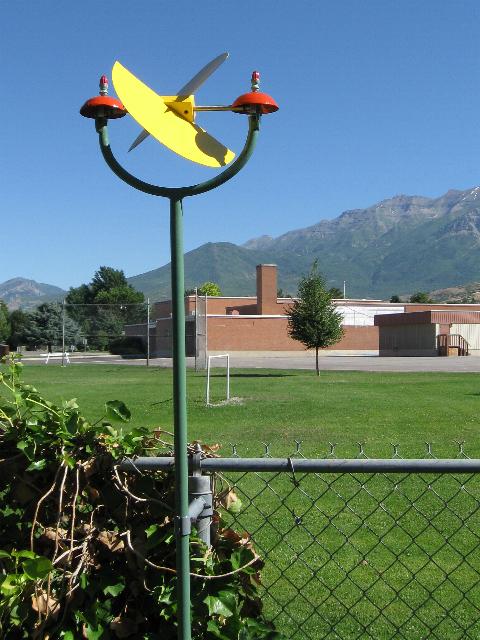
Flutter Mill


I have not been able to think up another project to work on, and to
keep from going nuts from boredom in the mean time, I made a Pantanenome
(pan-ta-nen-o-mee). I do not know why they call them that, the word is
not even in the dictionary. It means "all winds", and is supposed to
spin no matter what the direction of the wind. I tested it during
construction, and it does. It was mounted on top of the 6 foot chain link
fence that runs across the back yard separating us from the school yard.
In my research it appears that Pantanenomes originated in France, and maybe
that is why the word is not listed in an English dictionary. The inventor claims that
they will turn by wind from any direction, except perpendicular to the axis, however
that is true of most any propeller type wind mill, and all of them are more efficient
when oriented properly into the wind.
It is kind of fun to build replicas of wacky old inventions.

Saturday, July 3, 2010

Miniature Punch Press

The newest creation to emerge from the workshop is a miniature punch press just about 8" tall, and was completed just yesterday, July 2nd, 2010. Surprisingly it even works, quite well in fact.

Here it is shaping out dime sized pie tins. For what use? By mice, of course!

Wednesday, May 12, 2010

Dundee Foundry Engine


Recently I became intrigued by a patent design sketch shown in a book about model Stirling engines, and ended up building a model. A 45 hp double displacer engine built in 1843 to power the machinery of the Dundee Foundry, in the UK. The original engine ran for four years before failing due to poor materials of that day that could not withstand the intense heat.

There was not much to go on in the sketch, but that provides a lot of liberty to the builder. It was necessary to modify a couple things to make a working engine, but I tried to maintain a resemblance to the sketch. I hope you like it.

Wednesday, March 24, 2010

ROCK CRUSHER


The project for March was a model of a vintage Jaw Type Rock Crusher. It is a tough little bugger and will actually crush real rocks. However that takes more torque than the little electric motor provides, so I just use it to crush cough drops.

To prove it, these rocks were crushed during the testing stages.


Here it is munching some cough drops.

Sunday, February 21, 2010

Hypocycloidal Steam Engine


February was a good month to stay indoors and construct another scale model. This time it was a model of a Hypocycloidal steam engine. That is just a fancy tongue twisting word for geared crank engine. The original engine was invented in 1802 in England by a gentleman named Matthew Murray.
Building of this model was pretty simple and straight forward. The most interesting part was machining the internal toothed ring gear, I done that on the milling machine using it like a hand powered vertical shaper. Even though it is a lot of work there is a lot of satisfaction in making your own gears, especially if they need to have a special shape of some kind. When finished the engine turned out to be smooth running with an interesting motion.


Friday, January 29, 2010

Section Car


January marked the completion of a scale model hand pumped antique railroad section

Wednesday, December 9, 2009

8 Stomp 'ore Mill


Another object for the display room has just been completed. It is a whimsical facsimile of the century old stamp mill ore crushing machines.

Monday, December 7, 2009

Steeple Engine

Near the end of October a model of a Steeple Engine was completed. The plan was acquired out of the book titled Historic Engines Worth Modeling, by Anthony Mount, an Englishman. The reason for picking this one was that it had a different kind of connecting rod than and that I have built so far. The design provides for a shorter engine than the usual cross head arrangement. The author stated that it was designed as a marine engine, however the only ones ever built were used on land. After studying the plans, I determined that by changing the plan slightly, all I needed to make was a steeple pattern. For all the rest I was able to use existing patterns that I had made for other models. As can be seen in the video it is a smooth running engine.

Friday, October 23, 2009

Fancy Calipers


Have you ever wondered just how much some people have between the ears? Well, with my new fancy calipers it is not difficult to measure.
In my case, if you are wondering, it turned out to be mostly just space!

Treadle power wood turning lathe


On September 28 2009 I completed the construction of a 1/12 scale model of a wood turning lathe built from a kit P M Research castings given to me by my friend Paul Kuhni. Paul is 87 and reached a point in life where he just cannot tolerate standing at his lathe anymore. Although in the past he has built many marvelous models.
This is the smallest scale that I have worked to, and there were some pretty small parts, bit I managed just fine.
Normally I do not work with kits, as I prefer to scratch build things, but I guess there are exceptions to all rules.

Friday, September 18, 2009

Hay Fork


In 1986 a small building in the shape of an old gambrel roof barn was built in the back yard for storage and display of models and collected things. This was a common shape of a barn used a century ago to store hay. Although this barn will never be used to store hay, I thought that it would be neat to have a miniature Jackson type hay fork hanging from a trolley under the gable end like there would have been on the original barns, used to hoist loose hay up off the wagons through a big door and into the barn.
Last weekend that desire was fulfilled when I got a miniature fork hung up. The use of this type of hay handling was discontinued about 60 years ago when farmers switched over from putting hay up loose to bailing it.

Thursday, August 27, 2009

Panther Pup Gasoline Engine


Last Friday, August 21st, I completed another little engine to put on display. It is called a Panther Pup. It is fully functional four cylinder engine, although not a scale model of of any particular prototype. Just another fun little thing to build.

Monday, June 1, 2009

Pedal Grinder

A hundred years ago very worthwhile piece of equipment for a farmer to own was a pedal grinder. It could be use to sharpen everything needing sharpening from sickle blades to butcher knives. When my grandfather Sorenson passed away, I was fortunate enough to inherit his grinder. He use to keep it out in the yard under the apple tree, and all us kids use to take turns pedaling it. It seemed worthy to build a model of, and so just yesterday I completed a 1/8th scale model of it.

Wooden Lock

A couple weeks ago I completed a working lock, built entirely out of wood and glue, for no reason other than just doing it.

Fill In Engine

I had a desire for some kind of different project, and I happened across a web site in England that had instructions for building a little hand cranked box organ. After watching and listening to a number of videos of various ones playing, I placed an order for a set of instructions. But as anyone knows who has ordered anything from across the ocean, it takes time to get here. So while I was waiting I put together this little vertical engine. It did not take much because I was able to use a left over steam cylinder from the steam shovel and the flywheel is a spare belt pulley from the sawmill. It is intriguing, because it has rather different straight line motion linkage that eliminates the need for a cross head guide. The timing was perfect, I completed it march 4th just as my package from England arrived.
The organ was finished about the first of May, but that is another story, and hopefully a video of it will get posted one of these days.

"Fancy Calipers"

One day while looking through an 1897 issue of the Sears Roebuck catalog I ran across a listing for some fancy calipers. They looked pretty handy and the price seemed very reasonable at 8 cents, but Sears, for some reason would not honor the order. Perhaps that catalog was too far out of date. Rather than go without I proceeded to make a pair of my own. I finished them February 22, and I was pleasantly surprised how well they work. Those "old timers" knew what they were doing!

Tool Post Grinder


When building the Gator gun in January I took an old 3/8" worn reamer and ground it down to .360 diameter so I could ream the barrel to 36 caliber. To grind it down I rigged a die grinder to the lathe tool post. It got the job done, but the setup was a little less than satisfactory, so that prompted building a solid tool post grinder of my own design. It was constructed almost entirely of on hand materials, except I did salvage a motor and speed control from a little Harbor Freight grinder. It was completed February 4th.

January was a busy month


After being under construction for 10 weeks, on January 9th 2009, a half scale model of a Winchester Model 1892 was completed. It is fully functional, just like a full sized one, except it cannot be shot because there are no bullets commercially available that will work in it. This is the same model as so often was used in John Wayne and Chuck Connors movies.


On January 21 a rather whimsical under hammer muzzle loading pistol was completed. I call it my Gator Gun, and by golly it has proved to be pretty effective. I have not seen a single Gator in the whole county since it was finished


The month was finished up on the 29th of January by completing a mini .22 caliber revolver. It is fully functional, but it was decommissioned so that it will not shoot bullets. I did not want to take a chance of someone getting hurt with it.

Sunday, November 16, 2008

Bimba Too


After building so many engines a person starts to look for something different and unusual. A geared engine seemed to fit the bill. I have only seen one actual model, plus pictures of a couple others. I understand that they were patented by a fellow named Murray in 1908, but I have no knowledge if they were ever manufactured.
The engine employs a planetary gearing system. A point on the pitch line of the small hear generates a perfectly straight line from side to side, this eliminating the need for a cross head and connecting rod. The piston rod connects directly at that point.
This is just one of several model engines that I have built using surplus Bimba Brand pneumatic cylinders, and that is where the name came from. To add interest, it is equipped with a chain driven rotary valve and painted gaudy contrasting colors. Hope you like it.

Watch it in Action.