Saturday, November 5, 2011
Cement Mixer
Wednesday, October 12, 2011
James Watt Engine Model
Saturday, July 30, 2011
Ding Dong
If the cord is pulled slowly it produces a pleasant ding dong sound.
Now being equipped with both bells and whistles, our home is a pretty snazzy place.
Sunday, July 10, 2011
Spiritual Living
The Begonias seemed to be a little puny this year so I made a trip to the Morgue and got some fertilizer. It is cheap and they have plenty. They will give you for free, all you want of people who do not pay their bill.
The Begonias ought to really start growing now, maybe even pass up that big green flower.
Actually the inspiration for this one came from the cover picture of a book that I had ordered.
It looked like someone had been smashed by an old cast iron bath tub.Hopefully we a can find another hint for next month. Until then Happy gardening!
Thursday, June 16, 2011
New Invention for Washing Bottles
Actually the real reason for building the thing was that I seen a picture of the crank motion that intrigued me. As you can see in the video it is a smooth running machine, but as with all scale models they seem to run too fast, and so you cannot fully appreciate the combined rotation and reciprocating of the brush.
Thursday, June 9, 2011
Jewel of a vice
Refinements to the Mini Lathe
Acquisition of the mini lathe happened at a slack time, and after building the first engine with it and getting acquainted, being spoiled as I am, I thought it needed some more refining. The square tool post that comes with the lathe is sturdy enough, but awkward to use because there is no height adjustment and no good way of changing tool bits back and forth to the exact position when changing between operations. Also the tail stock lock was by tightening a nut with a wrench. Because of such close quarters, it was difficult. I concluded it needed a quick change tool post and a cam lock on the tail stock. These things are available on the market place for money, but I was looking for something to make anyway, So I took the quick change off the big lathe and dissembled it to see how they work. Then a trip to the drafting table to sketch up a mini version.
The cam lock was built first. It was a pretty simple project, and really smoothed out the unlocking moving and re locking of the tail stock. It is almost a one move operation now.
Tuesday, May 3, 2011
Mini Stuff
Last month when the Home Shop Machinist magazine arrived it contained a Harbor Freight ad with some coupons for equipment at very attractive prices. One of them was a 7"x10" Mini lathe. I do not really have a need for one because my 13"x40" Jet lathe will do everything a mini will do, but I have always wanted one because they are like babies, cute, however it is hard to justify something on that basis. In a moment of weakness I went to the Harbor Freight store over in Orem and a mini lathe followed me home. When I opened the box, I found that like all brand new babies it was covered with a layer of slick icky gooey stuff, so the first order of business was a bath to clean it up.
After clean up, it was time to start getting acquainted with the new baby. I started by making a tool bit height setting gauge, as seen below.
Then a storage rack was attached to the chip guard for the tools and accessories.
All that preliminary work done, it needed to be tested, so parts for a "Mini" engine were machined on it. Oh, what fun! It was like using a toy that really works. I was quite favorably impressed with its performance. The engine was completed yesterday afternoon. The head bolts, by the way are size "0", little bigger than watch screws.
And finally here is a 3 second video to show that it runs. I had plans to attach it to a wood base, but it is so smooth and well balanced, that it does not need a larger base.
Friday, April 15, 2011
Joseph Bernays engine of 1878
Some time ago I seen a picture and video of a Bernays engine on Lindsay Publishing website that has an interesting motion. I do not know anything about the engine, whether the originals were a successful design or not. On the website it indicated that the engine had been exhibited by Joseph Bernays of London at the Paris Universal Exposition in 1878. However it looked like a good canidate for a model so I built one. It was finished yesterday. It runs beautiful, and will throttle down so you can see the parts in motion other than a blur. It will be a fine exhibit for the display room.

Just in case you are wondering, that dark thing on the bottom is a "Footing". I have heard all big engines need a footing to support them.
Sunday, February 20, 2011
Stirling's First
There were concerns if it would even run because the timing was somewhat different that most hot air engines and not not too much could be done to change it and still look like the illustration.
When it was to a point where the engine part was complete, heat was applied to the hot end with a small Butane torch, and as soon as it was heated sufficiently it ran beautifully.
Being satisfied with the initial test, construction proceeded until it was finished and placed on display, as seen in the first two pictures.
Saturday, January 22, 2011
Twin Cylinder Geared Wobbler
Here is a short video of it in action.
Tuesday, January 11, 2011
Corliss Steam Engine Model
Thermo Acoustic Engine
Way back on June 1 2007 I completed a Thermo Acoustic Engine that actually runs. Just don't ask me how or why, because I don't know. I had bought a book authored by Warbrooke over in New Zealand about building one, and I built it per the instructions, but that engine would not even attempt to run. I gave it up as a hoax. Then later I seen some videos on the Internet, and also acquired another book written by Roy Darlington in England. Roys book had a short 4 page chapter on them. No plans, but a good description, so I proceeded to build another one, and by golly it actually runs under its own power. Not very fast, but it does run. Here take a look.
Sunday, September 5, 2010
Hand Cranked Box Organ
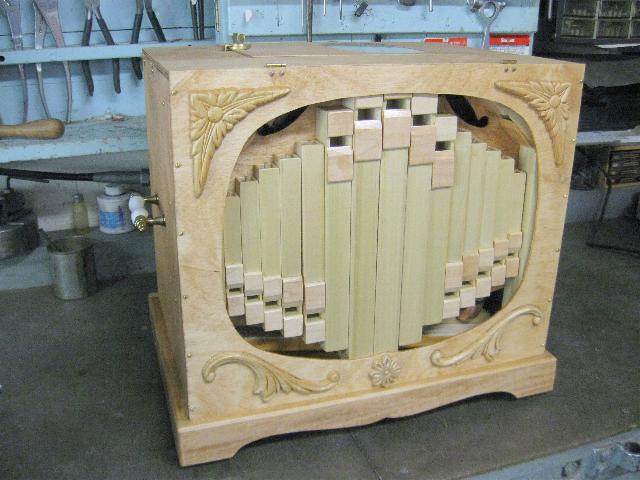
The top is hinged so that it can be opened up and you can look down inside and see the working mechanism. The crank operates bellows to pump air and also powers the punched paper roll that distributes the air to the 20 pipes to play the tunes. It works somewhat like a player piano.
Saturday, September 4, 2010
Kaleidoscope
The interesting thing, was that in reading some history, I found that the Kaleidoscope was invented by David Brewster in 1816, the same year that Robert Stirling invented the hot air engine. (I've built a bunch of hot air engine models) Both men attended the university of Edinburgh in Scotland, they may have known each other. Although the Kaleidoscope is more or less a toy or object of fascination, David went on and did a lot of research and development with optics, and other fields of science. David was the inventor of the Fresnel lens that was used in light houses all over the world. A very respected gentleman.
Saturday, August 14, 2010
Jackhammer
I just finished building a little jackhammer a couple days ago, for no reason other than I was curious how they worked, and there is no better way to find out than to build a working model.
The display stand is a small burl from a Popular tree. It is not a bolder, but a good representation of one.
Yes, it does go Rat-a-tat-tat, or maybe more of a Putt Putt Putt, but it does work, and only requires a few pounds pressure from an Air Brush Compressor.
Tuesday, July 27, 2010
7" Atlas Shaper
On the middle day of July I had the oportunity to acquire a couple Atlas metal shapers that were being disposed of at the local high school. Actually it was a bunch of shaper parts in various states of assembly or disassembly, which ever way you'd like to say. Although I already had a shaper that is seldom used, I simply could not pass up something like that. In their day shapers were state of the art machines. However, they, like model T Fords, have become obsolete. They are no longer manufactured and seldom used, but they are fun to play with. You can still do machining operations with them, but not near as efficiently as with a milling machine.
One looked like it was almost complete, and the other was missing many of its parts.
Having no other project to work on at the time, I immediately started working on the better of the two. Who ever had worked on it before me had left out some internal parts and had others installed incorrectly, so it was torn completely down and started over.
About 5 or 6 days later I had it back together and operational. A lot of time was spent getting all the slide ways adjusted to minimum clearance without any binding. Several parts needed repairs, and the tool post was missing completely, so a new one was machined. Everything was in excellent condition and being so complete, with guards and even the original Atlas motor, it was exchanged with the old shaper on the cabinet. I have not decided what to do with the old one yet.
Here is a little video of it in operation shaving of a block of metal.
The finish is just beautiful, as smooth as a spanked baby's bum.
That is not the end of the story. The spare parts shaper were give to my friend Lowell. He needed a table and a few of the internal parts to finish up the restoration of a machine that he has been working at for the past couple years. Needless to say he seemed quite happy too. His machine is shown below in its state of restoration as of a couple days ago.
Having no other project to work on at the time, I immediately started working on the better of the two. Who ever had worked on it before me had left out some internal parts and had others installed incorrectly, so it was torn completely down and started over.
The finish is just beautiful, as smooth as a spanked baby's bum.
That is not the end of the story. The spare parts shaper were give to my friend Lowell. He needed a table and a few of the internal parts to finish up the restoration of a machine that he has been working at for the past couple years. Needless to say he seemed quite happy too. His machine is shown below in its state of restoration as of a couple days ago.
Subscribe to:
Comments (Atom)